![[beyt] by 2bdesign](http://2bdesign.biz/cdn/shop/files/logo_beyt_pdf_fond_transparant_aug_2013_100x.png?v=1637929094)
About the artist: Bénédicte de Vanssay Moubarak
“A house lived in for many years, which we leave, does not leave us. In the emptiness of its courtyards and rooms, something of the soul remains.”
— Michel Chiha
For more than twenty years, the architectural and cultural heritage of Lebanon has deeply inspired Bénédicte de Vanssay Moubarak. It carries a unique character shaped by layers of history, at the crossroads of cultures and borders, marked by multiple influences, catching light in unexpected ways, and embodying both hospitality and life.

The Beyt Archive
Artist, social entrepreneur, urban explorer, and founder of Beyt, Bénédicte has spent much of her life searching for beauty in places often overlooked. From abandoned houses and architectural fragments to forgotten objects and fading memories, her work is guided by a desire to preserve what time, conflict, and neglect threaten to erase.
Together with Raja Moubarak, she founded Beyt in 2005, a social enterprise dedicated to transforming salvaged architectural elements from regions affected by conflict in Lebanon and Syria into meaningful home objects through upcycling.
The intention was to revive fragments of a neglected heritage by giving them new life as functional, living objects. The workshop also created employment for people facing social and economic vulnerability, such as individuals living with disability, marginalization, or exclusion, across different backgrounds and beliefs.
Beyt's mission was to restore the unseen beauty of the broken—whether it is people, cultural heritage, intercommunal relationships, or the environment.


From the beginning, Beyt also documented each object: where it came from, and what it once was. Each piece remained connected to its origin through photographic archives of homes marked by decades of civil war, and later by the pressures of post-war real estate speculation.
In 2019, as Lebanon entered a deep economic collapse, followed by the catastrophic explosion of August 4th, 2020. In this context, Beyt gradually came to an end, and in 2023 the workshop officially closed its operations, after having sold over 15,000 upcycled objects around the world.
A New Meaning
Countless historic homes were further damaged or lost during the Beirut explosion and the latest wars. Only a few were restored, often through private means or humanitarian support. Bénédicte returned to urban exploration, photographing what remained of this fragile architectural memory. These images became the foundation for a new practice in watercolor and mixed media.
She paints destroyed houses, collapsing ceilings, and walls marked by time, attempting to breathe life and color back into spaces in suspension. Her works sometimes incorporate collage elements: aged papers, dried flowers, and fragments of Syrian marquetry, extending the physical and emotional texture of the places she depicts.
Through painting, she aims to continue the same gesture that shaped Beyt: to preserve what is disappearing, and to reveal the dignity of what remains.
"I paint abandoned houses.
I take photographs during urban explorations, particularly in Lebanon.
I am drawn to the beauty behind destruction, behind ruins.
What does it mean to leave a house behind?
I work in watercolor, sometimes adding collage, dried flowers, and fragments of fabric.
Through these layers, I try to tell the stories of those who are forced to leave everything behind.
Because this could happen to any of us.”

Creative Process Behind the Paintings: Urbex in Lebanon
Anyone walking through Beirut and across Lebanon cannot help but be moved by the urban upheaval—nothing quite resembles anything else, and yet it carries an irresistible charm. When you add the scent of jasmine and orange blossom mingling in the air, and walk beneath the shade of mauve tamarisk trees, the enchantment becomes complete.
This country, far from being spared, still retains a surprising capacity to move forward. From one war to the next, through corruption, economic collapse, and the ultimate shock of the August 4th explosion, Lebanon continues to survive inexorably, perhaps refusing to fully acknowledge its wounds and to tend to them.
Its heritage has been deeply undermined; for a long time it was not a priority, and when it finally became one, it was almost too late. The observation is clear, almost surgical: hundreds of small palaces and beautiful late 18th- and 19th-century houses now stand abandoned, torn open, exposed to the wind. Sometimes a patron awakens and transforms the abandoned beauty into a boutique hotel; most of the time, the multiplication of heirs scattered across five continents makes any action impossible. Collapsing roofs are covered with plastic sheets, waiting for… something, no one quite knows what. A few fortunate owners carefully maintain their treasures, hoping no new bomb will ever strike them.

"For a long time, I have travelled across the country in search of these ghostly places, first to photograph them, and later to paint them.
I can testify: all these houses—Beyt in Arabic, a powerful word symbolizing a place of gathering and welcome—have kept a soul. Despite destruction, abandonment, the uncontrolled intrusion of nature inside them, despite graffiti and dust, broken floors and shattered roofs, there is always something—a light, a pink or turquoise wall, a delicately painted frieze, a sepia photograph, a chandelier, a wisteria still clinging to the façade; objects that fascinate me and carry me into the history of the place. Behind them, there are men and women, dreams—broken.
Urban exploration (urbex) carries certain risks, but with care and respect, I open doors that allow themselves to be opened, or I ask neighbors for help. When the sun is there, the photographs bring light and brilliance. Otherwise, I imagine…
Urbex is a way of making the invisible visible and preserving the memory of forgotten places. It allows me to tell stories, and sometimes to draw attention to urgent social realities."
Why Watercolor?
Watercolor is an extraordinary medium for expressing emotion. It is fluid and unpredictable; it flows, runs, escapes the brush, and eventually settles as its pigments migrate and find their place on the paper. Layers of washes can be built up gradually—sometimes four or five deep—creating a sense of depth and texture that is often essential when painting the marks left by time. Faded walls, peeling paint, weathered surfaces, and traces of former lives emerge naturally through these translucent layers.
Watercolor is also an exercise in letting go. It requires accepting that not everything can be controlled. Once the water begins to move, the painting develops a life of its own. In that surrender, emotions find space to surface freely—sometimes gently, sometimes with force, reflecting an inner state that cannot always be expressed in words.
For Bénédicte, watercolor imposed itself naturally as the medium best suited to her subject matter. Like the abandoned houses she paints, it is fragile, unpredictable yet enduring. It captures both presence and disappearance, allowing memory, light, and emotion to coexist on the page.

Why Mixed Media?
Using collage over paint means stepping into dreams and imagination. Hands move quickly between paper, scissors, and craft knives, assembling fragments and layering stories.
Collage is a process of accumulation: a wash of watercolor, a piece of paper, perhaps a touch of gold, a fragment of Syrian marquetry, a scattering of dried flowers. Layer by layer, the work begins to take on a life of its own. The image unfolds through details, inviting the eye to wander across the composition, discovering unexpected connections and following hidden threads.
While watercolor allows her to capture the atmosphere of a place, collage gives her the freedom to move beyond reality. It introduces memory, symbolism, and imagination, creating a dialogue between what is seen and what is felt.
Collage also helps her to tell difficult stories. Sometimes, the inclusion of a piece of golden silk, an old document, or a delicate flower can soften the gravity of a subject without diminishing its importance. These fragments bring lightness, tenderness, and humanity to places and histories marked by loss.

Learn more about Bénédicte's journey, and explore her paintings here.
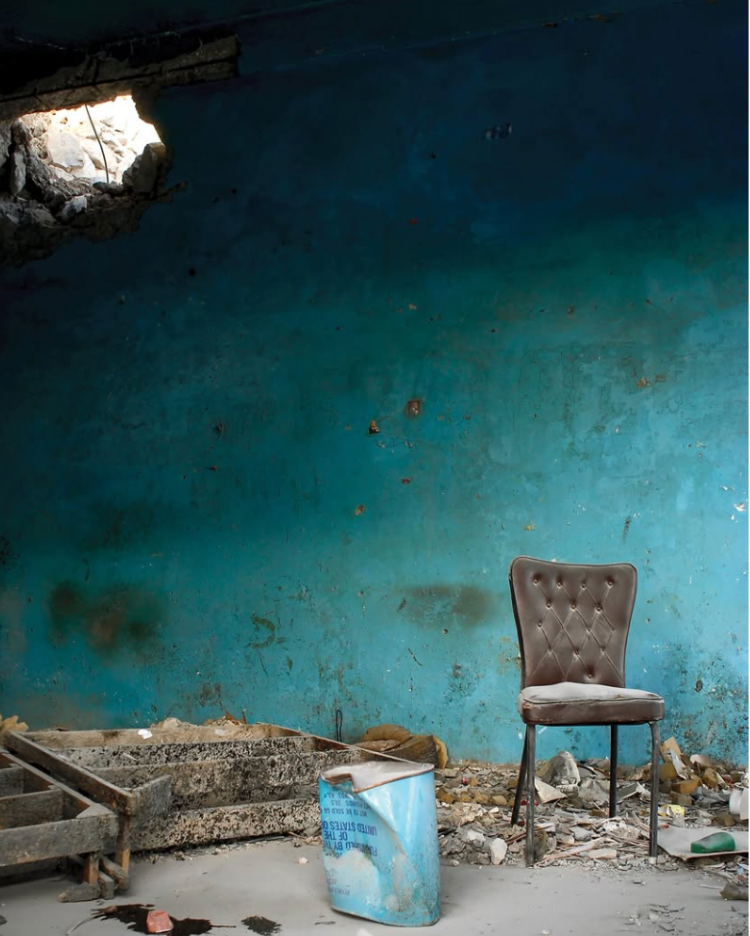
"Urbex, for me, is a way of making the invisible visible again. It allows me to preserve fragments of memory before they disappear, and to tell stories that might otherwise be lost."
Photo: La chaise by Rania Matar
Featured collection: Watercolor
-
Original Watercolor What Happen to My Roof 35X50
Regular price €700,00 EURRegular priceUnit price per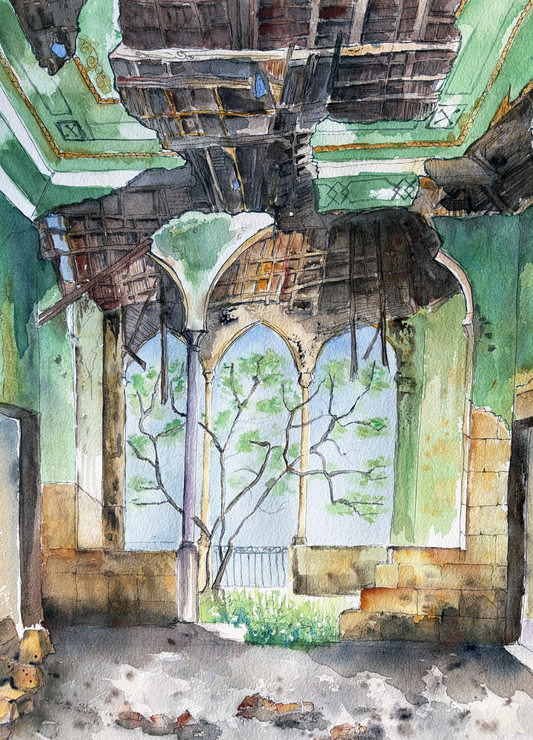
-
Original Watercolour Golden light 80 X 60
Regular price €700,00 EURRegular priceUnit price per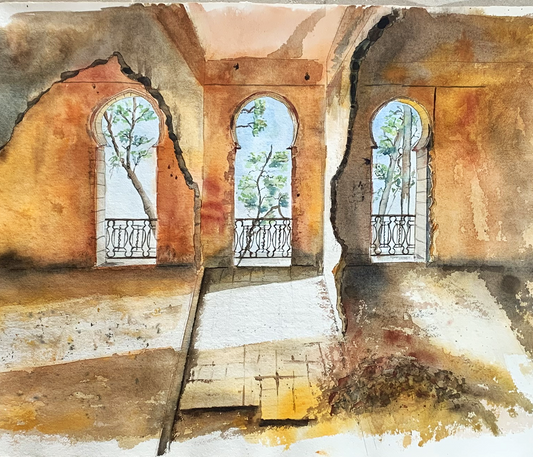 Sold out
 -
Original Watercolor Sheltering in Style 36 X 50
Regular price €500,00 EURRegular priceUnit price per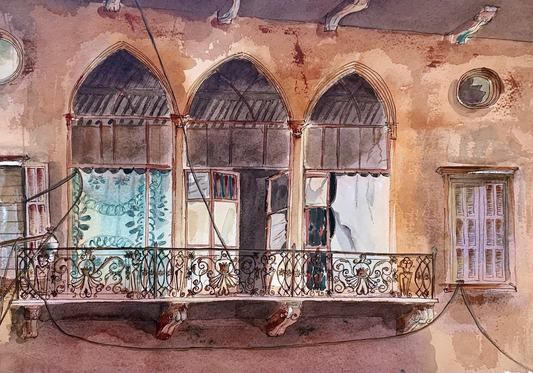
-
Original Watercolor La Maison Verte - Abandon 36 X 50
Regular price €500,00 EURRegular priceUnit price per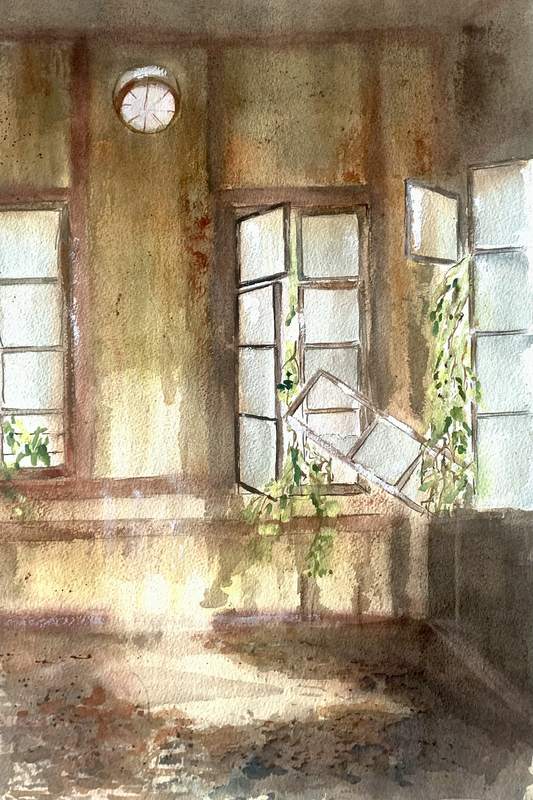
Featured collection: War & Consequences
-
Original Watercolor War and Consequences The Cooking Queen
Regular price €400,00 EURRegular priceUnit price per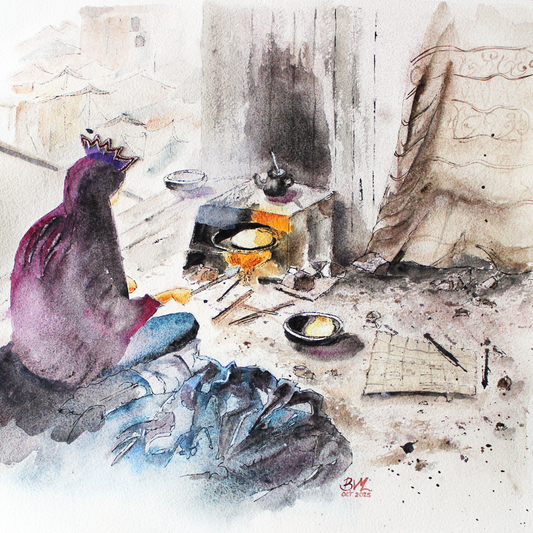 Sold out
 -
Original Watercolor War and Consequences Still Hanging
Regular price €400,00 EURRegular priceUnit price per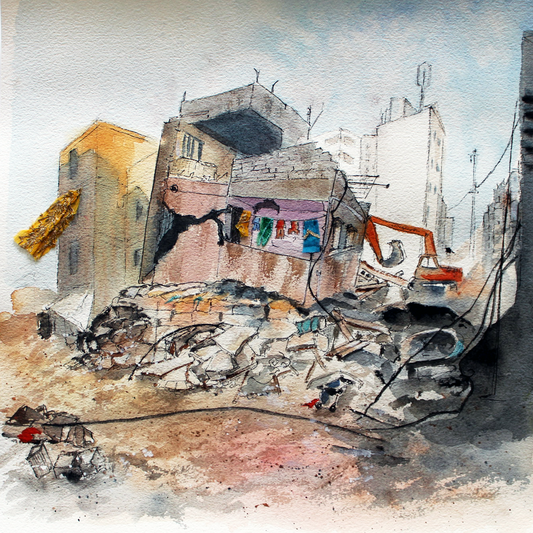
-
Original Watercolor War and Consequences Resilience
Regular price €400,00 EURRegular priceUnit price per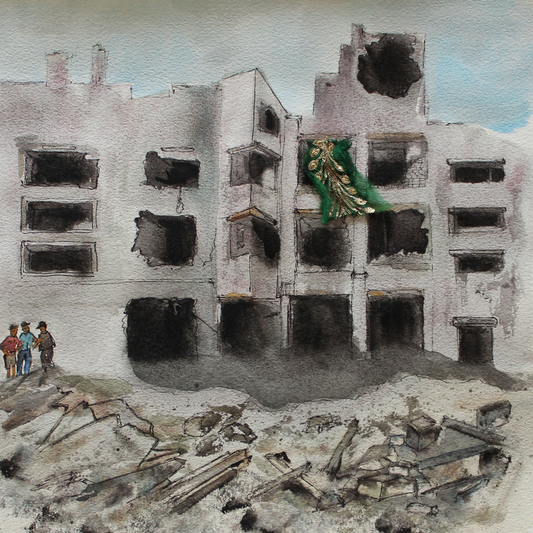
-
Original Watercolor War and Consequences Moving On
Regular price €400,00 EURRegular priceUnit price per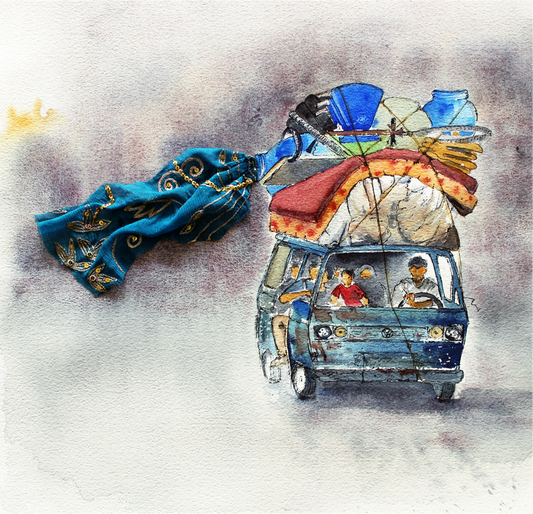 Sold out
